Oculoplastic surgeons train for 11 to 13 years before performing a single eyelid procedure — and that gap in subspecialty depth is exactly what separates an outstanding outcome from a mediocre one.
Demand for eyelid and orbital surgery has grown significantly in recent years, yet fewer than 600 ASOPRS-credentialed surgeons practice in all of North America. Eyelid surgery demands that level of precision. This guide covers what oculoplastic surgeons do, how they train, what procedures they perform, and why subspecialty credentials matter for your outcome.
Key Takeaways
- An oculoplastic surgeon is a fellowship-trained ophthalmologist who specializes exclusively in the eyelids, orbit, tear system, and surrounding facial structures
- ASOPRS credentialing requires passing both ophthalmology board exams and rigorous ASOPRS written and oral examinations — the gold standard in the field
- Oculoplastic surgery covers both cosmetic procedures (eyelid lifts, brow lifts) and complex reconstructive care (thyroid eye disease, blepharospasm, orbital tumors)
- PESA’s surgeons have each performed over 95,000 procedures — more than any other oculoplastic practice in Texas, with 7,500+ thyroid eye disease decompressions alone
What Oculoplastic Surgery Covers — and Why Subspecialty Training Matters Now
Search “eyelid surgery Houston” and you’ll get general plastic surgeons, facial plastic surgeons, dermatologists, and the occasional oculoplastic specialist. They don’t all train the same way. They don’t all carry the same credentials. And when a procedure sits within millimeters of the eye itself, that difference isn’t cosmetic.
This guide covers what an oculoplastic surgeon actually does — the training pathway, the procedures, the credentialing, and what a consultation at Plastic Eye Surgery Associates looks like in practice. Cosmetic procedures, reconstructive care, thyroid eye disease, blepharospasm. All of it.
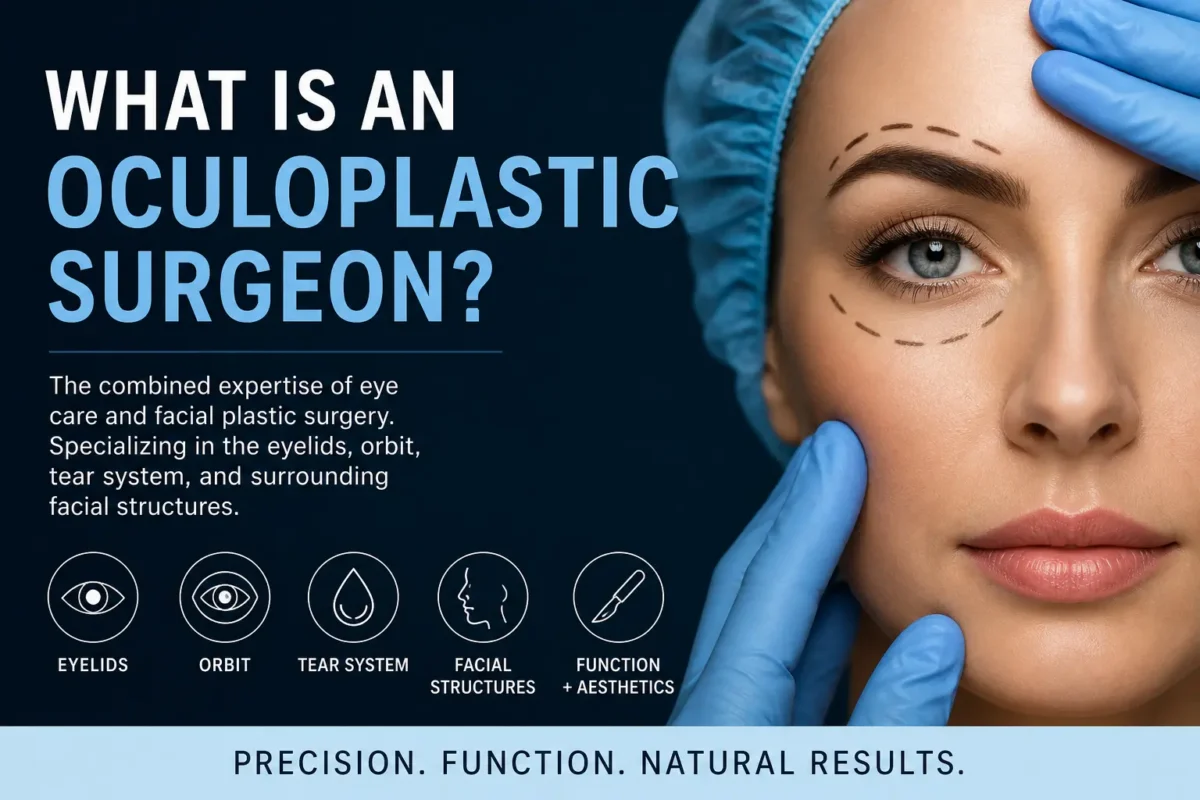
The term “oculoplastic” combines two disciplines: ocular medicine and plastic surgery. But unlike a general plastic surgeon who operates across the entire body, an oculoplastic surgeon works in one of the smallest anatomical zones in medicine. Every incision, every suture, every repositioned tissue sits within millimeters of the eye.
The American Society of Ophthalmic Plastic and Reconstructive Surgery (ASOPRS) recognizes oculoplastic surgeons as the most highly trained specialists for procedures involving the eyelids, orbit, and lacrimal system. Membership isn’t a formality. It requires passing both the American Board of Ophthalmology certification and a separate set of rigorous ASOPRS written and oral board examinations.
The anatomical territory of an oculoplastic surgeon includes:
- Upper and lower eyelids
- Eyebrows and forehead
- Orbit (the bony eye socket and its contents)
- Lacrimal (tear) system — including tear ducts and drainage passages
- Midface and periorbital soft tissues
- Cheek and adjacent facial structures
The Oculoplastic Surgeon Training Pathway
Eleven to thirteen years. That’s the minimum from the start of medical school to ASOPRS credentialing. Most surgical specialties don’t come close.
Medical School (4 Years)
Four years, M.D. or D.O. Anatomy, physiology, pharmacology, pathology, clinical medicine across every specialty. It’s the foundation — but it’s only the foundation.
Internship (1 Year)
Many physicians complete a general medical or surgical internship before residency. Another year of training before the subspecialty work even begins.
Ophthalmology Residency (3–4 Years)
This is where the separation happens. Ophthalmology residency is built around microsurgical precision — suture work measured in microns, operating under high magnification, developing an intimate knowledge of ocular anatomy that no other residency provides.
The American Academy of Ophthalmology describes ophthalmology as one of the most technically demanding surgical specialties because of the precision required at submillimeter scale. General surgery doesn’t teach this. It can’t — the scale is fundamentally different.
ASOPRS Fellowship (1–2 Years)
After residency, the surgeon pursues an oculoplastic fellowship at a recognized institution. Aesthetic eyelid surgery, complex reconstructive procedures, orbital surgery, lacrimal surgery, thyroid eye disease, blepharospasm. Full subspecialty immersion.
And to become a full ASOPRS member? A peer-reviewed publication. On top of the written and oral board examinations.
Eleven to thirteen years. Minimum.
Oculoplastic Surgeon vs. Plastic Surgeon: The Training Gap Is Real
Patients ask this constantly. It’s a fair question — and the answer carries real clinical weight.
A board-certified plastic surgeon trains across the entire body. Burn care, hand reconstruction, breast surgery, abdominal procedures, trauma repair. That breadth builds strong general surgical skills. But it doesn’t include the microsurgical eye training that ophthalmology residency provides. Sutures used in general surgery are orders of magnitude larger than those used in ophthalmology. When a plastic surgeon operates on the eyelids, they’re working in a zone that — by training — belongs to a different specialty.
The AAO notes that oculoplastic surgeons have the combined advantage of understanding how the eye functions, not just how the eyelid looks. That distinction matters when complications arise, when vision is at stake, or when a condition like ptosis or entropion needs correction without disrupting the underlying ocular surface.
At Plastic Eye Surgery Associates, both Dr. James R. Patrinely and Dr. Charles N.S. Soparkar are ASOPRS-credentialed. Fewer than 600 surgeons in North America hold that credential. Both trained at Baylor College of Medicine and completed fellowships at Johns Hopkins Medical Center, Massachusetts Eye and Ear Infirmary, and M.D. Anderson Cancer Center. Dr. Soparkar also holds a Ph.D. in molecular biochemistry and has done extensive research in tissue aging.
Key differences at a glance:
- Training focus: Oculoplastic surgeons train exclusively on the eye and face from the start; plastic surgeons train across the whole body
- Suture scale: Ophthalmology uses sutures measured in microns; general surgery uses significantly larger sutures
- Vision safety: Oculoplastic surgeons understand ocular surface mechanics — not just cosmetic outcome
- Credentialing: ASOPRS requires passing two separate board examinations; plastic surgery board certification doesn’t include oculoplastic-specific testing
- Procedure volume: PESA performs over 1,000 blepharoplasties per year — a volume no general plastic surgery practice in Texas matches
Cosmetic Eyelid Procedures: What PESA Performs More Than 1,000 Times a Year
Cosmetic eye surgery is the most common category of oculoplastic care at PESA. These procedures address the eyes and surrounding face — not by dramatically changing appearance, but by restoring what age or anatomy has altered.
Lower Eyelid Lift (Lower Blepharoplasty)
Lower eyelid lift surgery addresses under-eye bags, puffiness, dark crescents, and sagging skin below the eye. Techniques vary: transconjunctival blepharoplasty leaves no external scar. Fat repositioning, skin tightening, canthoplasty — the right approach depends on your anatomy.
Upper Eyelid Surgery (Upper Blepharoplasty)
Upper eyelid surgery removes excess skin, fat, and tissue from the upper lid — the tissue that makes eyes look heavy, tired, or partially closed. When that excess skin obstructs the visual field, the procedure may also qualify for insurance coverage.
Blepharoplasty — Combined Upper and Lower
Blepharoplasty refers to eyelid surgery in its broadest form. Upper, lower, or both together. PESA performs more than 1,000 blepharoplasties every year — one of the highest volumes of any practice in the United States.
Cosmetic Ptosis Correction
Droopy eyelid surgery corrects a cosmetically descended upper lid. The eyes look asymmetrical, sleepy, fatigued. It’s distinct from functional ptosis repair — though the techniques overlap significantly.
Brow and Forehead Lift
Descending brows crowd the upper eyelid space and create a heavier, sadder appearance than the patient actually feels. Short-incision hairline techniques can elevate the outer brow edge. No full forehead incision required.
Male Eyelid Surgery
Male blepharoplasty requires a different philosophy. The goal isn’t feminized or dramatically changed — it’s refreshed, natural, masculine. PESA has extensive experience with male eyelid surgery and facial rejuvenation.
Reconstructive Eyelid and Orbital Procedures: When Insurance Covers Surgery
Reconstructive oculoplastic procedures address conditions affecting the function, health, and structural integrity of the eyelids and orbit. Many are covered by medical insurance — not because they’re elective, but because the eye depends on them.
Ptosis Repair
Ptosis repair corrects a functionally drooping upper eyelid caused by weakening of the levator muscle. When the lid obstructs the visual field, the procedure is medically necessary. Insurance typically covers it when properly documented.
Entropion and Ectropion Repair
Entropion turns the eyelid inward. Ectropion turns it outward. Both malpositions cause significant ocular surface damage, chronic tearing, and discomfort that don’t resolve on their own. Surgery restores normal lid position and protects the eye.
Eyelid Reconstruction and Mohs Surgery Reconstruction
Eyelid reconstruction is required after skin cancer removal, trauma, or prior surgery complications. Mohs reconstruction — rebuilding the eyelid after cancer removal — is one of the most technically demanding procedures in the oculoplastic field. Precise tissue transfer. Form and function, both.
Orbital Fracture Repair and Orbital Tumors
Orbital surgery covers fractures to the bony eye socket after facial trauma, removal of orbital tumors, and management of proptosis (forward displacement of the eye). Complex cases. High stakes. Requires the combined expertise of ophthalmology and reconstructive surgery.
Tearing (Epiphora) and Lacrimal Surgery
Blocked or narrowed tear ducts cause chronic tearing that artificial tears can’t fix. The primary surgical solution is dacryocystorhinostomy (DCR) — a new drainage pathway created directly from the tear sac into the nasal cavity.
According to MedlinePlus, published by the U.S. National Library of Medicine, most patients who undergo oculoplastic procedures resume normal activities within two weeks. Recovery varies by procedure.
Thyroid Eye Disease: Why Patients Travel Nationally to PESA
TED — thyroid eye disease, Graves’ ophthalmopathy, Graves’ eye disease — is one of the most complex conditions in all of oculoplastic surgery. It’s also where PESA has more experience than any other practice in the United States.
Thyroid eye disease happens when the immune system attacks the tissues behind the eye. Inflammation. Swelling. Proptosis. Double vision. Eyelid retraction. In severe cases, vision loss from optic nerve compression. It’s closely associated with Graves’ disease — but it can occur in patients with entirely normal thyroid function.
The American Thyroid Association estimates TED affects approximately 25–50% of patients with Graves’ disease. Most patients don’t know that until they’re already managing it.
Surgical management requires a staged approach — and the sequence matters:
- Orbital decompression — removing bone or fat to create space for the expanded orbital contents
- Strabismus surgery — correcting double vision caused by muscle fibrosis
- Eyelid repositioning — correcting upper and lower eyelid retraction
- Cosmetic refinement — final aesthetic procedures once the disease is stable
PESA has performed more than 7,000 thyroid eye disease orbital decompressions. More than any other practice in the United States. Patients come from across the country — and internationally — including cases where prior surgery elsewhere produced incomplete or complicated results.
Blepharospasm Treatment: 40 Years of Experience, Starting in the Mid-1980s
Blepharospasm is neurological. It’s not a cosmetic problem or a dry eye problem — it’s a focal dystonia, classified as such by the National Institute of Neurological Disorders and Stroke (NINDS). Abnormal impulses from the brain’s basal ganglia cause involuntary, forceful closure of the eyelids.
In its most severe form, essential blepharospasm leaves patients functionally blind despite having perfectly healthy eyes. The lids won’t stay open.
PESA has been treating blepharospasm with botulinum toxin since the mid-1980s. That’s not a marketing claim — it’s a clinical history that spans decades of refinement. Treatment options managed at PESA include:
- Oral medications — useful for mild cases, rarely effective long-term for moderate to severe blepharospasm
- Botulinum toxin injections — the primary treatment; PESA’s experience here is among the deepest of any practice in the world
- Myectomy — surgical removal of the overactive eyelid muscles for patients who don’t respond adequately to injections; both limited and extensive myectomy are performed at PESA
Cosmetic Injectables: Botulinum Toxin and Dermal Fillers
PESA’s injectable work isn’t cosmetic add-on service. It comes from clinical research that’s influenced practice globally.
Dr. Charles N.S. Soparkar co-developed research on nutritional supplements that enhance botulinum toxin efficacy. He separately identified the enzyme responsible for dissolving hyaluronic acid fillers. That research is cited by injectors worldwide.
Botulinum toxin at PESA treats:
- Forehead lines, crow’s feet, neck bands, and glabellar frown lines — cosmetically
- Blepharospasm — therapeutically, not cosmetically
- Lower facial contouring
Dermal fillers — hyaluronic acid products like Restylane — address volume loss in the under-eye hollow, mid-face, and perioral areas that surgery alone can’t correct.
What to Expect at Your First Oculoplastic Consultation
For most patients, this is the first time they’ve spoken with a surgeon who specializes in exactly their concern. That’s different from a general consultation — and it shows in how the appointment runs.
The evaluation starts with a thorough review of your medical history, current medications, and any prior eye surgeries or treatments. Reconstructive patients should bring records from referring physicians — ophthalmologists, endocrinologists, oncologists, neurologists. PESA reviews them before making recommendations.
The examination is precise. Eyelid position measured in millimeters. Visual fields tested when indicated. Photographs taken for documentation and surgical planning. For TED patients, exophthalmometry — a direct measurement of how far the eye protrudes from the orbit — is recorded at every visit.
No pressure. That’s not a sales line — it’s the practice’s operating philosophy, built over nearly 30 years. Patients leave with information and make decisions on their own timeline. Surgeons recommend only what’s medically or aesthetically indicated. Nothing more.
Cost and insurance get discussed directly. Procedures performed in PESA’s Houston office carry no facility fee — a significant cost advantage over hospital or surgery center-based practices. Insurance coverage for reconstructive procedures is reviewed at consultation. General anesthesia is rarely needed. IV sedation by a board-certified anesthesiologist is available when you want it.
Oculoplastic Surgery in Houston: Why Patients Travel to PESA
Houston sits at the center of the Texas Medical Center — the largest medical complex in the world. PESA’s primary office at 3730 Kirby Drive, Suite 900 is within that corridor. A consultation office in The Woodlands serves the north Houston corridor. A third location in Pensacola, FL serves the Gulf Coast.
But patients don’t travel from Dallas, San Antonio, Austin, and out of state for the location. They travel for two things: thyroid eye disease orbital decompression and complex revision blepharoplasty. No other oculoplastic practice in Texas has performed more decompressions.
For patients already in Houston, the practical advantage is straightforward. Most procedures happen in the office. No hospital facility fee. Local anesthesia with optional IV sedation. Home the same day.
How to Choose an Oculoplastic Surgeon: What to Do Before Your Consultation
Verify ASOPRS Credentialing
Don’t take a claim of “oculoplastic training” at face value. ASOPRS membership requires passing both the American Board of Ophthalmology certification and separate ASOPRS written and oral board examinations. Fewer than 600 surgeons in North America qualify. The member directory at asoprs.org is publicly searchable. Use it.
Review Procedure Volume
Ask how many of your specific procedure the surgeon performs per year. Not procedures in general — your procedure. PESA performs more than 1,000 blepharoplasties annually and has completed more than 7,500 thyroid eye disease orbital decompressions. Volume isn’t everything. But for high-stakes procedures near the eye, it’s something.
Prepare Your Medical History
Bring a complete list of current medications before your first appointment — particularly blood thinners, aspirin, and NSAIDs, which must typically be paused before surgery. Note any prior eye surgeries, thyroid conditions, neurological diagnoses. Arriving prepared means more time for examination and planning. Less time on intake paperwork.
Understand the Insurance Question Early
Ptosis repair, thyroid eye disease surgery, blepharospasm treatment, entropion and ectropion repair, lacrimal surgery — these are typically covered when properly documented. Cosmetic blepharoplasty and brow lifts are not. PESA reviews eligibility at consultation. Know before you come in whether your procedure is likely to qualify. It changes how you plan the visit.
What Oculoplastic Surgery Achieves: Outcomes by Procedure Category
Cosmetic Procedures
Blepharoplasty results last a decade or more for most patients. The improvement is permanent in the sense that you’ll always look younger than you would have without surgery — aging continues, but from a better baseline. At PESA, the philosophy is conservative. Anatomy-driven. You shouldn’t look operated on. You should look like yourself, well-rested.
Functional and Reconstructive Procedures
Ptosis repair restores the visual field. Patients who’ve lived with a drooping lid for years describe the change as immediate and life-altering. Entropion and ectropion repair ends the chronic ocular surface damage and tearing that eye drops can’t touch. Mohs reconstruction rebuilds the eyelid’s structure and mechanics after cancer removal — not just its appearance.
Thyroid Eye Disease
Orbital decompression reduces proptosis and relieves optic nerve compression. In many cases, it prevents vision loss. The full staged sequence — decompression, then strabismus correction, then eyelid repositioning — can take a patient from severe functional impairment back to normal appearance and full vision. PESA has done this more than 7,500 times.
Blepharospasm
Properly administered botulinum toxin lets patients with essential blepharospasm open their eyes and function normally. For patients who don’t respond to injections, myectomy can provide lasting relief that injections alone can’t. PESA has been doing this since the mid-1980s. The depth of experience matters here more than almost anywhere else in the practice.
The PESA Oculoplastic Surgery Guide Series
This is the master guide. Each procedure category covered above has a dedicated deep-dive guide — links added as each one publishes.
- Eyelid Surgery Guide 2026 — Coming soon
- Blepharoplasty: Upper, Lower, and Combined — Coming soon
- Thyroid Eye Disease Surgery: Stages, Outcomes, and What to Expect — Coming soon
- Ptosis Repair: Functional and Cosmetic Droopy Eyelid Surgery — Coming soon
- Lacrimal Surgery and Blocked Tear Duct Treatment — Coming soon
- Blepharospasm Treatment: Botox, Myectomy, and Long-Term Management — Coming soon
Frequently Asked Questions About Oculoplastic Surgery
Defining the Specialty
1. What does an oculoplastic surgeon do that a regular plastic surgeon does not? The training is different at a fundamental level. An oculoplastic surgeon completes full ophthalmology residency before the oculoplastic fellowship — meaning they understand how the eye functions, not just how the eyelid looks. That distinction matters most when something goes wrong, when vision is at stake, or when a condition like ptosis needs correction without disrupting the ocular surface. General plastic surgery training doesn’t provide this.
2. What does ASOPRS stand for and why does it matter? ASOPRS is the American Society of Ophthalmic Plastic and Reconstructive Surgery — the primary credentialing organization for oculoplastic surgeons in North America. Membership requires passing both American Board of Ophthalmology certification and separate ASOPRS written and oral examinations. Fewer than 600 surgeons in North America hold it. It’s not an honorary designation.
3. Is an oculoplastic surgeon also an eye doctor? Yes. Every oculoplastic surgeon first trained as an ophthalmologist — a physician specializing in the medical and surgical care of the eye. The oculoplastic fellowship is an additional layer on top of that. So when your oculoplastic surgeon examines your eyelid, they’re also thinking about what’s happening to the eye underneath it.
4. How long does it take to become an oculoplastic surgeon? Eleven to fourteen years from the start of medical school. Four years of medical school, a year of internship, three to four years of ophthalmology residency, one to two years of ASOPRS fellowship. And full ASOPRS membership also requires a peer-reviewed publication. Most surgical careers don’t involve this level of layered credentialing.
5. How many oculoplastic surgeons are there in the United States? About 600 active ASOPRS members in all of North America. By comparison, there are roughly 7,000 board-certified plastic surgeons in the United States. That scarcity is why patients travel regionally, nationally, and internationally to practices like PESA.
Cosmetic Eyelid Procedures
6. What’s the difference between upper and lower blepharoplasty? Upper blepharoplasty removes excess skin, muscle, and fat from the upper lid — the tissue that causes heaviness, hooding, and that fatigued appearance. Lower blepharoplasty addresses under-eye bags, puffiness, dark hollows, and sagging skin below the eye. Both can be done together or independently. Depends entirely on your anatomy and what you’re trying to correct.
7. Will there be visible scars? Upper eyelid incisions sit inside the natural lid crease. Once healed, they’re typically invisible. Lower eyelid scars, when an external incision is used, are placed just below the lash line — they fade significantly within three to six months. For patients with minimal excess skin, the transconjunctival approach puts the incision entirely inside the lower lid. No external scar at all.
8. How long do blepharoplasty results last? Over a decade for most patients. Aging continues after surgery — but you’ll always look younger than you would have without it. Sun exposure, smoking, and genetics influence how quickly things change. The improvement is permanent in that sense.
9. Can eyelid surgery look natural? It should. Over-corrected eyelids — the classic “operated look” — come from removing too much tissue or positioning structures incorrectly. PESA’s philosophy is conservative and anatomy-driven. The result should make you look rested and refreshed. Not different. Not done.
10. What’s the recovery time? Most patients are back to social activities within seven to ten days. Bruising and swelling in the first one to two weeks — that’s normal. Full results, including complete scar maturation, take three to six months. Most PESA procedures happen in the Houston office. No facility fee. Home the same day.
Reconstructive and Medical Procedures
11. Does insurance cover oculoplastic surgery? It depends on medical necessity. Functional ptosis repair, thyroid eye disease surgery, blepharospasm treatment, entropion and ectropion repair, lacrimal surgery, and orbital fracture repair are typically covered when properly documented. Cosmetic blepharoplasty and brow lifts are not. PESA reviews eligibility at the time of consultation — not after.
12. What is thyroid eye disease and can it be treated surgically? TED is an autoimmune condition. The immune system attacks the tissues behind the eye — causing swelling, proptosis, double vision, eyelid retraction, and in severe cases, vision loss from optic nerve compression. It’s most commonly associated with Graves’ disease, but it can occur with normal thyroid function. Surgery is highly effective and staged: orbital decompression first, then strabismus correction, then eyelid repositioning. PESA has performed more than 7,500 orbital decompressions — more than any other practice in the U.S.
13. What is blepharospasm and how is it treated? It’s a neurological movement disorder — involuntary, forceful closure of the eyelids that, in severe cases, prevents patients from opening their eyes at all despite normal vision. Botulinum toxin injections are the primary treatment. PESA has been administering them since the mid-1980s. Patients who don’t respond adequately are candidates for myectomy — surgical removal of the overactive muscles.
14. What is Mohs reconstruction of the eyelid? After a dermatologist or oncologist removes eyelid skin cancer using Mohs micrographic surgery, the resulting defect needs to be rebuilt by an oculoplastic surgeon. It’s one of the most technically complex procedures in the field. Precise tissue transfer to restore both function and appearance. Not every oculoplastic surgeon does high volumes of this. PESA does.
15. Can oculoplastic surgery correct complications from prior eyelid surgery elsewhere? Yes. Revision blepharoplasty is a significant part of PESA’s practice. Both Dr. Patrinely and Dr. Soparkar are sought out by other surgeons — and by patients who experienced complications elsewhere — for complex revision cases. Lagophthalmos, lid retraction, asymmetry, over-resection, scarring. PESA accepts surgical referrals from across the United States and internationally.
Planning Your Visit to PESA
16. Where are PESA’s offices located? Three locations: the primary office at 3730 Kirby Drive, Suite 900, Houston, TX 77098; a consultation and clinic location in The Woodlands, TX; and a location in Pensacola, FL. Patients from outside these markets travel to Houston regularly for complex cases.
17. Is general anesthesia required? Rarely. General anesthesia is reserved for the most complex orbital and tear drain procedures — performed at Houston Methodist Hospital. The majority of PESA’s procedures happen in the office under local anesthesia. IV sedation by a board-certified anesthesiologist is available. It reduces cost, reduces risk, and lets you recover at home the same day.
18. How should I prepare for my consultation? Bring a complete medication list — especially blood thinners, aspirin, and NSAIDs, which typically need to be paused before surgery. Relevant medical history: prior eye surgeries, thyroid conditions, neurological diagnoses. If you’re being referred by another physician, bring those records. The more context you bring in, the more useful the consultation.
19. How do patients choose between Dr. Patrinely and Dr. Soparkar? Both are ASOPRS-credentialed and handle the full range of cosmetic and reconstructive oculoplastic procedures. Dr. Patrinely founded the practice in 1997 and has authored more than 175 published works. Dr. Soparkar brings additional depth in oncology-related eyelid conditions and injectable research — more than 150 additional publications. Patients are matched to the surgeon whose subspecialty experience most closely fits their specific case. Both accept complex referrals.
20. Does PESA accept physician referrals? A significant portion of the practice is physician-referred — from ophthalmologists, endocrinologists, oncologists, neurologists, and other surgeons. Both Dr. Patrinely and Dr. Soparkar are called upon by colleagues for complex, revisional, and oncology-related cases. Referring physicians can reach the Houston office directly at (713) 795-0705.
About Plastic Eye Surgery Associates
Plastic Eye Surgery Associates was founded in Houston in 1997 by Dr. James R. Patrinely. Three locations now — Houston, The Woodlands, and Pensacola, FL. Both Dr. Patrinely and Dr. Soparkar hold ASOPRS credentials, a distinction fewer than 600 surgeons in North America can claim. More than 180,000 procedures performed. More thyroid eye disease orbital decompressions than any other practice in the country. Complex referral cases accepted from ophthalmologists, endocrinologists, oncologists, and surgeons across the United States and internationally.
Talk to an Oculoplastic Surgeon at Plastic Eye Surgery Associates
Nearly 30 years in Houston. More than 180,000 procedures. The highest volume of thyroid eye disease cases in the United States. Consultations are unhurried. Insurance eligibility reviewed at the visit. Most procedures carry no hospital facility fee.
Call (713) 795-0705 (Houston and The Woodlands) or (850) 473-0990 (Pensacola). Request an appointment online. Same-day consultations available for urgent reconstructive and medical referrals.